Quick answers to what people are searching this week
Is hantavirus contagious between humans? Almost never. The strain on the cruise ship, called Andes, is the only one widely accepted to spread person-to-person, and even that is rare. The strain American homeowners actually face (Sin Nombre virus, carried by the deer mouse) does not pass between people. You catch it from rodent droppings, urine, or saliva, almost always by breathing in dust from a contaminated space.
What are hantavirus symptoms? Fever, severe muscle aches (especially thighs, hips, lower back), headache, fatigue, and shortness of breath, starting 1 to 8 weeks after exposure. The respiratory phase comes next and comes fast. CDC notes most fatalities happen within 24 to 48 hours after the cardiopulmonary phase begins.
How worried should I actually be? If you haven't been on the MV Hondius and you don't have rodents in your house, almost zero. If you have a mouse problem in an attic, basement, shed, or crawlspace, the answer is different and worth reading.
What the cruise ship story actually tells us
If you've turned on the news this week, you've heard the word hantavirus more than you've heard it in your entire life. A Dutch-flagged cruise ship called the MV Hondius is sitting off Cabo Verde with three dead, several more sick, and contact tracers in Arizona, California, Georgia, Texas, and Virginia trying to find passengers who already flew home. The WHO is calling it a multi-country cluster. The strain involved is called Andes, which is unusual because hantavirus rarely passes from person to person, but Andes can.
The Andes strain is rare. It's named for its first identification in Argentina and Chile, and it's the only hantavirus widely accepted to spread human-to-human. The WHO's risk assessment for the cruise outbreak is alarming because of the geography (passengers in 17 countries), not because Andes is suddenly more dangerous than it was a month ago.
What's notable for U.S. readers is the underlying number. CDC pegs the case fatality rate of hantavirus pulmonary syndrome at roughly 38%. The Pan American Health Organization tracked 229 cases across the Americas last year with 59 deaths. That's the death rate of a disease most people in this country could not have named ten days ago.
You don't need to panic. You do need to know how it actually gets into a person.
How Americans actually catch hantavirus
In the United States, the strain that matters is Sin Nombre virus. The carrier is the deer mouse, Peromyscus maniculatus, which lives in basically every state. The mouse sheds the virus through urine, droppings, and saliva. The virus survives in dried droppings and dust for days, sometimes longer.
Here is the part nobody likes to read: the way a person catches it is by breathing it in.
When you sweep, vacuum, or even walk briskly across a floor coated in dust from old droppings, you aerosolize the virus. It's now in the air you're breathing. There is no skin contact required, no bite required, no living mouse required. A nest a year old, in an attic nobody visits, is still infectious if it gets disturbed.
Symptoms show up one to eight weeks later. The early phase looks like flu: fever, muscle aches, headache, shortness of breath. The cardiopulmonary phase comes next, and it comes fast. CDC notes that without adequate treatment, most HPS deaths happen within 24 to 48 hours after the cardiopulmonary phase begins.
There is no specific antiviral. There is no vaccine. The treatment is supportive, in an ICU, with a ventilator if it gets bad enough. Survival depends on getting there before your lungs fill up.
The high-risk spaces in your house
The CDC, state health departments, and provincial health authorities (the Canadian guidance is unusually clear) all flag the same set of places:
- Attics and crawlspaces left closed through winter
- Detached sheds and barns
- Cabins and seasonal homes opened in spring
- Garages with stored boxes or insulation
- Basements with rodent activity
- Outbuildings on rural properties
The pattern: enclosed spaces, with rodent traffic, that haven't been ventilated. The very rooms most people clean out in May.
If you've found droppings in any of those spaces, the conventional advice you've probably read online is incomplete. "Wear a mask and bleach it" is technically what the CDC says. It is also written for someone who's already trained to use the protection correctly, in a small contained area, with a known boundary.
Most homeowners aren't in that situation.
Why DIY hantavirus cleanup fails most of the time
A few specific things go wrong, every time, in a normal household cleanup.
The mask is wrong. A surgical mask does almost nothing. A KN95 helps, but the CDC and OSHA both call for an N100 or P100 respirator for any heavy infestation. Most people don't own one. The ones at the hardware store are often counterfeit if you don't know what to look for.
The vacuum is the worst tool. A standard household vacuum aerosolizes everything it picks up and blows it through the room. Even HEPA-rated vacuums are tested to standards that don't cover viral particles in dust. If you've already vacuumed an attic with droppings, the air in that attic has been contaminated for hours.
The sweeping is the second-worst tool. Same problem, more localized. Dry sweeping is the textbook wrong move.
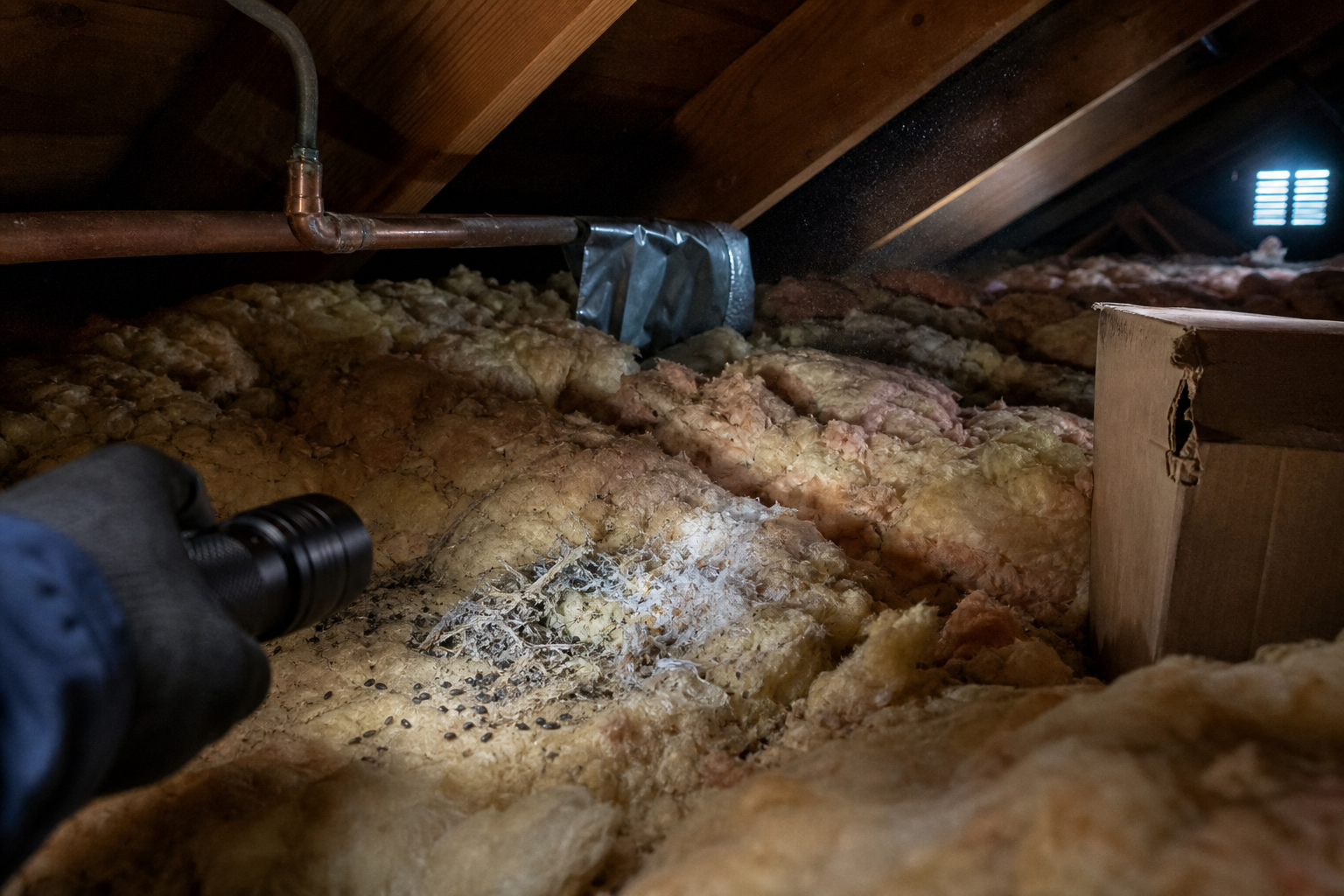
The "wet it down with bleach for ten minutes" instruction assumes you found everything. In a crawlspace, you didn't. Deer mice nest behind insulation, in wall voids, in ductwork, in places you cannot see. The droppings you spotted are a fraction of what's in there.
The disposal step is rarely done right. CDC says double-bag the waste and put it in a covered outdoor trash can. Most people just bag it and toss it in the kitchen bin, which means dust gets back in the house.
None of this is moralizing. The CDC instructions assume more PPE, more containment, and more space-control than a normal Saturday afternoon allows. That's why the case fatality rate is what it is.
When to call a professional for hantavirus cleanup
Three honest tests.
Surface area. If the contaminated space is bigger than a bathroom, you're already past the size where DIY cleanup is realistic. An attic, a crawlspace, a shed, a cabin, a basement, an outbuilding, none of those qualify as small.
Density. A single old dropping near the back of a kitchen cabinet is something you can handle, with the right mask and the right method. A nest, multiple piles, a smell, or insulation visibly tunneled through is not.
Knowability. If you can't see all of the contamination at once, it's bigger than you think. Crawlspaces and attic eaves both fall into this category by definition.
If any of those three apply, the right move is a biohazard-trained cleanup crew, not a Saturday with a Swiffer. We do this work because doing it wrong has consequences that show up six weeks later in an ER.
What we do on a hantavirus-risk job
A short list, because people ask.
- Site assessment. Identify all entry points and nesting areas, not just the visible ones.
- Containment and ventilation. Set up airflow that pushes out, not in. Doors, fans, sometimes negative-pressure equipment depending on the size.
- Proper PPE. N100 or P100 respirators, full body cover, gloves doubled, eye protection. Not optional, not improvised.
- Wet cleanup only. EPA-registered disinfectant, applied and dwelled per label. No dry sweeping, no dry vacuuming, ever.
- Material removal. Insulation that's been used as nesting material is not cleaned. It's removed and replaced.
- HEPA air scrubbing. After wet cleanup, before reentry without PPE.
- Disposal. Double-bagged biohazard waste, transported and disposed per state regs.
- Exclusion. Sealing the entry points, because the cleanup doesn't matter if the mice come back next month.
The whole protocol exists because aerosolized particles don't care about your weekend plans.
The short version
The cruise ship outbreak is a reminder, not a forecast. The far more common American hantavirus story is a homeowner who opened a shed, a cabin, or an attic in the spring, swept up some old droppings, and felt fine for three weeks before they didn't.
If you've found rodent droppings in an enclosed space at home this week, the news cycle is doing you a favor. It's making you take seriously something you might otherwise have written off as a Saturday chore.
Don't sweep it. Don't vacuum it. Open the windows, walk away, and call somebody who does this for a living.
That's what we're here for.